Photo Stitch Rose: A Designer Review for Small Brand Merch
Every embroidery designer who works with small businesses eventually looks at a single flower design with a very specific question: Will this help my client sell more, or will it just look pretty on scrap fabric? Photo Stitch Rose arrived in my test folder last week, and after stitching it out on multiple base fabrics and imagining it on everything from a café apron to a handmade soap label, I can say with confidence — this machine embroidery design has serious business potential, but it also demands respect for its detail and a clear plan when you use it for commercial embroidery.
First Impressions: What Photo Stitch Rose Feels Like for a Brand
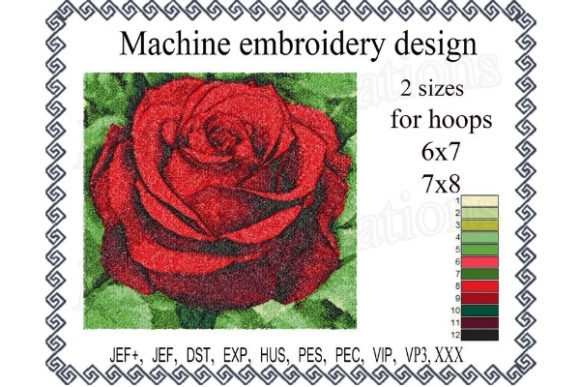
Opening the Photo Stitch Rose file, the first thing that hits me is the balance between photographic realism and clean stitch structure. This is not a cartoon rose or a flat vector icon. True to its name, the design uses layered shading and what appears to be a careful color blend — the kind of texture that, on a finished product, reads as premium handmade detail rather than mass-produced decoration. For a small business owner, that difference is everything. When a customer touches an embroidered patch on a tote bag, they immediately judge the quality of the entire brand. Photo Stitch Rose suggests attention, patience, and care.
The Single Flowers category gives you a hint of where this design shines: stand-alone focal points. It is not a border pattern or a repeating motif. This rose wants to be seen clearly, perhaps as a chest logo accent, a sleeve badge, or the centerpiece of a custom cap design. From an embroidery designer’s point of view, this kind of focused visual can become a surprisingly flexible design asset when you match it to the right product category.
How Photo Stitch Rose Performs on Real Business Merchandise
Testing this embroidery file on commercial items instead of just hooped stabilizer samples changed my perspective. Here is how Photo Stitch Rose translates onto the merchandise that actually moves inventory for independent brands and embroidery shops.
Embroidered Patches: A Business Card You Wear
Cut-and-sew patches remain one of the smartest merch investments. With Photo Stitch Rose, you get an embroidered patch that can be applied to denim jackets, tote bags, canvas backpacks, and even customer gift wrapping accents. When I tested the design at a patch-friendly width around 2.5 inches, the petal definition held beautifully. The thread colors appeared saturated without feeling artificial. For a florist, a handmade bakery, or a pet brand with a soft, natural identity, a Photo Stitch Rose patch on a branded canvas pouch instantly upgrades the perceived value.
Apron Embroidery: Face-to-Face Branding
Aprons live in the customer’s eye line. Whether it is a coffee shop barista, a craft workshop instructor, or a boutique sales associate, the person wearing the apron becomes the brand. Placing Photo Stitch Rose on the upper left chest of a linen or cotton canvas apron gave it a friendly, approachable, yet polished feel. There is an old-school craft energy here that works perfectly for businesses that sell handmade goods. However, I strongly recommend a test stitch on your exact apron fabric — loose weaves and thick textures can swallow fine petal shading, and this design relies on its subtle color transitions to communicate quality.
Cap Embroidery: Small Space, Big Statement
Caps are brutal editors of embroidery designs. Curved surfaces, structured front panels, and a limited safe embroidery field force you to ask hard questions. Photo Stitch Rose, when sized for a cap front (typically 2.2 to 2.5 inches wide), retained its identity but lost some of the finest interior detail. For caps, I found the design worked best as a slightly abstract rosy texture rather than a tiny photograph. If your client insists on a cap, consider moving the design to a side placement or a lower-profile unstructured hat where the fabric lies flatter. For structured caps, test first; the rose may need slight digital editing to open up delicate stitch gaps.
Tote Bag Design: Everyday Branding That Ages Gracefully
A tote bag with a single Photo Stitch Rose becomes a walking advertisement that doesn't scream. I stitched this on a medium-weight cotton tote, and the texture of the design paired beautifully with the natural slub of the fabric. Totes are also forgiving when it comes to wash-and-wear cycles. Because the design is dense but not overly heavy, it flexed with the bag rather than creating a stiff, crack-prone patch. If your business sells at markets or sends purchases home in branded totes, this design can become a signature mark. One important note: dark totes demand very different thread colors than the original palette. Always test a reduced-contrast version for dark fabric, or the rose will look like a bright sticker rather than soft embroidery.
Where You Should Test Photo Stitch Rose Before Final Production
Not every surface loves this design. Through my test runs, several caution areas emerged that every embroidery business owner should address before promising delivery to a client.
- Small patch sizes below 2 inches. Fine petal detail starts to merge into colored blobs. Keep this design bold enough to read.
- Extremely textured fabrics like fleece or terry. The stitch definition suffers, and the realistic effect becomes muddy.
- Dark base materials without thread color adjustments. This is not an outline-heavy design; it depends on value contrast.
- Items that require constant industrial washing. The denser shaded areas, while durable, benefit from a protective layer if used on uniforms in food service or cleaning industries.
- Curved cap fronts with high crown profiles. Registration problems can warp the rose asymmetrically.
For branded merchandise, the safest starting point is a flat or gently curved, medium-weight woven fabric in a light to mid-tone. From there, you can push the design into more challenging placements with proper testing.
The Impact of Photo Stitch Rose on Brand Identity and Customer Trust
A business is not just the logo. It is the emotional texture of every touchpoint. Photo Stitch Rose communicates a set of values without words: natural, attentive, timeless, handcrafted. For a small café that wants to distance itself from corporate chain aesthetics, this rose on a sleeve or a takeaway coffee cozy says "we care about detail." For an Etsy seller creating custom wedding goods, adding the rose to packaging or a thank-you card insert (fabric mounted) signals that the brand invests in presentation.
From a psychological level, real customers trust brands that display clear, deliberate visual consistency. When the same rose appears on a cap, a website product photo, a customer gift sticker (using a printable mockup), and an in-store apron, the business suddenly feels larger and more cohesive than its actual footprint. That is the power of a well-chosen digital embroidery file. Photo Stitch Rose can become a quiet logo alternative or a secondary brand mark, especially for businesses that avoid aggressive typography.
Practical Designer Notes Before Stitching Out Photo Stitch Rose
No design is plug-and-play if you care about the finished product. Here is my at-the-machine checklist after years of delivering commercial embroidery:
- Test in black and white first. Remove the color distraction. If the tonal structure of the rose reads clearly without hue, it will hold up on a variety of fabric tones. Photo Stitch Rose passed this test decently — the central swirl and outer petals kept spatial separation.
- Review thread color contrast with actual spools. Screen colors lie. The subtle pinks and greens in this design need real-world comparison against your chosen fabric.
- Check spacing and trims. Between petal sections, watch for long jump stitches. I found a few trims needed manual checking on my machine; if your file does not include automatic trims, plan for them.
- Confirm hoop size before anything else. The description does not list an exact hoop requirement. Do not assume. Measure the design dimensions in your software and match to the smallest comfortable hoop you own. No business can afford a re-hoop order because the field was too tight.
- Use proper stabilizer for the fabric, not the design. Cutaway for knits and shirts, tear-away for sturdy woven merchandise, and a topper for anything with nap. The design does not compensate for bad hooping or weak support.
- Create a realistic mockup for client approval. Use a digital photo of the actual garment with the stitched rose digitally placed. This simple step prevents 90% of "that's not what I expected" calls.
- Stitch beside other design assets. If the rose will live next to a wordmark, icon, or another floral element, test them together on a single piece of fabric. Visual imbalance between a smooth typeface and a textured rose can cheapen both.
- Verify commercial licensing. The product listing is your only source of truth. I always read the fine print of any Embroidery design file I use for client work. Confirm that small business merch resale is covered, and keep documentation.
I also recommend that embroidery shops keep a small physical swatch book of successful Photo Stitch Rose stitch-outs on different fabrics. When a new client asks, "What would this look like on my product?" you pull out the swatch and convert curiosity into confidence instantly.
Final Thoughts on Using Photo Stitch Rose as a Business Asset
Photo Stitch Rose is not a fill-every-inch pattern. It is a deliberate, single-statement design that, when placed wisely, adds real dollar value to handmade product lines, custom apparel, and branded merchandise. For small business owners inside the embroidery world — whether you run an independent digitizing service, an Etsy merchandise shop, or a local print-and-stitch storefront — this machine embroidery design offers a rare combination: artistic texture that still stitches cleanly, and a friendly botanical subject that fits dozens of niche markets without needing custom digitizing from scratch.
My personal rule with any Single Flowers digitized design is simple: Respect the scale, test the substrate, and match the mood to the brand. Photo Stitch Rose rewards that respect. If you treat it as a business tool and not just a pretty stitch file, you will end up with products that customers remember, reuse, and recommend.