Fairy Flower and Heart: A Brand-Ready Embroidery Design Review
First Impression: Playful, Handmade Charm with Commercial Potential
As an embroidery designer who’s digitized for 12+ years—and shipped thousands of units for small businesses—I opened Fairy Flower and Heart expecting whimsy. What I found was more: a cohesive, balanced composition that reads instantly as friendly, gentle, and intentional—not just “cute.” The title hints at fairy tale magic, but the design itself avoids over-saturation or clutter. It feels handmade without sacrificing polish—ideal for brands that want warmth *and* professionalism. For a florist launching branded aprons, a children’s boutique adding chest logos to organic cotton tees, or a bakery stitching custom totes for weekend markets, Fairy Flower and Heart delivers approachable elegance—not costume-level fantasy.
Real-World Performance Across Small Business Merch
This machine embroidery design shines where many floral motifs falter: scalability and context flexibility. As an embroidered patch, it holds clarity even at 2.5” tall—no lost petals or collapsed heart outlines. On staff uniforms (think café aprons or boutique smocks), it reads cleanly from 3 feet away, especially when stitched in high-contrast thread colors like navy on ivory linen or burgundy on natural canvas. For cap embroidery, position it subtly on the side gusset or back curve—it avoids the distortion common with dense circular motifs thanks to its open negative space and gentle curves.
For tote bag design, Fairy Flower and Heart works beautifully centered near the top seam or nestled in a corner as a signature accent—not overwhelming, but unmistakably *yours*. On product packaging (like muslin gift bags or reusable produce sacks), it adds artisanal credibility without looking mass-produced. And for Etsy sellers or handmade brands, it elevates customer gifts: stitch it onto mini pillowcases, tea towel hems, or fabric tags—reinforcing your brand identity through tactile, consistent detail.
Where to Use With Intention—Not Assumption
Don’t assume Fairy Flower and Heart auto-translates to every surface. On highly textured fabric (like bouclé or thick terry cloth), test stitch density first—excess fill can flatten dimension and mute detail. On dark uniforms, avoid light pastel threads unless you’re using underlay or topping stabilizer; contrast is non-negotiable for legibility. Avoid scaling below 1.75” without verifying outline integrity—some delicate petal tips may merge or vanish at tiny sizes, especially on curved cap fronts or narrow sleeve bands.
Also note: while the description mentions quilt blocks and baby items, this isn’t just “decorative embroidery.” Its clean line work and moderate stitch density make it viable for commercial wear—but only if tested on your *actual* production fabric. A lightweight poplin shirt won’t behave like denim or twill. Always confirm hoop size compatibility before batching—many small shops overlook how much time wasted re-hooping costs per unit.
Brand Identity Impact: More Than Just Pretty Stitching
Fairy Flower and Heart strengthens brand identity by signaling care, consistency, and human-centered design. Unlike generic clipart florals, it carries emotional resonance—ideal for businesses rooted in nurturing, creativity, or local charm (a pet wellness studio, indie bookshop, or herbal apothecary). Customers subconsciously associate that thoughtful detail with trust: if you invest in refined embroidery, they’ll believe you invest in quality ingredients, service, or craftsmanship.
It also supports visual consistency across touchpoints. Use it as a unifying motif: scaled down on fabric labels, enlarged on wall banners, simplified into a monogram for social media avatars. When paired with complementary design assets—like a custom font or color palette—it becomes part of your visual language, not just decoration. For handmade product lines, it signals authenticity without shouting “handmade”—a subtle differentiator in crowded markets like craft fairs or Etsy search results.
Practical Designer Notes for Production Readiness
Before cutting thread or approving client mockups, follow these steps:
- Test in black and white first—verify shape recognition and balance without color bias.
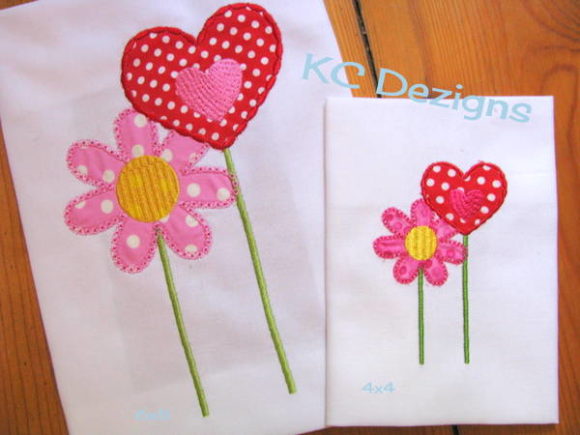
- Check minimum viable patch size—stitch a 2” version on your target fabric + stabilizer combo to assess petal definition and heart symmetry.
- Review thread color contrast—especially for high-wear items. A soft mint thread may fade visually on light gray twill after 10 washes.
- Inspect spacing between elements—ensure no floating stitches or awkward gaps between flower and heart that could snag or distort.
- Confirm hoop size requirements—if your shop uses 4x4 hoops exclusively, verify the design fits without splitting or repositioning.
- Test on real fabric, not just tear-away stabilizer alone—fabric texture dramatically affects stitch lay and density perception.
- Use proper stabilizer: cutaway for knits, medium-weight tear-away for stable wovens, and topping for napped fabrics.
- Create a printable mockup for client sign-off—show it on actual garment photos, not blank templates.
- Compare beside other design assets—does it harmonize with your logo, typography, and packaging? If not, adjust thread tones or scale.
- Confirm commercial licensing before bulk production—this digital embroidery file must be cleared for business use, not just personal projects.
Final Thought: A Strategic Asset, Not Just a Design
Fairy Flower and Heart stands out in the Fairy Tales category because it balances narrative charm with functional intelligence. It’s not merely embroidery—it’s a scalable brand element, a quiet ambassador for small business values: warmth, attention, and intentionality. Whether you’re embroidering 50 tote bags for a community event or building a signature look for your handmade product line, this embroidery file earns its place in your design assets library—if you treat it like the strategic tool it is. Test it thoroughly, pair it thoughtfully, and let it do quiet, confident work for your brand.